Sunday, June 27, 2010

Polk Museum of Art, Lakeland, FL

"Art is not a treasure in the past or an importation from another land, but part of the present life of all living and creating peoples." -- Franklin D. Roosevelt


The Louvre, the Hermitage, the Tate, the Prado, the Getty, the Uffizi, the Polk... OK, so it doesn't quite roll off the tongue. But there's nothing more satisfying than discovering a new treasure in your own backyard! Lagniappe, encore une fois.

After living in Polk County for nearly four years, it's inexcusable to have taken this long to get acquainted with what I'd heard was an excellent museum. Adding to the enticement is their free Saturday morning admission. Sometimes the best things in life are free!

The Polk has several rooms on the main level full of Pre-Columbian art reflecting highly developed empires from the Mexican desert down through the Andean rain forest. Works dating back to 600 BC with astounding sophistication and ornamentation. It struck me that, with all my focus on late medieval Gothic architecture, these figures and utensils would have seemed ancient to the people of the late Middle Ages! And many of them enjoyed a standard of living well above that of our European ancestors who came along centuries later.

The museum also proudly displays the best in children's art from this part of central Florida. I would give anything to be able to create like these 5 year-olds!

The museum also features a good selection of contemporary art, including a few pieces by Picasso, Matisse, and Duchamps. But the highlight this particular Saturday was a temporary exhibit of early to mid-20th century textiles from Japan (picture exquisite kimonos hung the length of the exhibit hall, like a forest of brightly colored, intricately embroidered silk trees.) With the textiles was a collection of 32 woodblock prints by 19th century Japanese artist Tsiuioka Yoshitoshi -- "32 Aspects of Women." Portraits of women from all classes of Japanese society, they were a lesson in the feminine esthetics and fashion of the day. For example, did you know that a green-painted lower lip and black teeth were considered the height of style for upper class women? A peek of red undergarment hinted at a "lady's" lack of virtue? That you can tell about a woman's station in life by translating the various twists and bobs of her hair? Fascinating! The final print in the series showed a traditional Japanese maiden wearing a western-style Victorian suit -- disconcerting to say the least!

In July, this exhibit will be replaced by a temporary show of work by Lois Mailou Jones, considered one of the Harlem Renaissance painters of the 20th century. Rejected early in her career because of her race and gender, she fled to Europe where she developed her talent. Her paintings show the influence of early 20th century Impressionism. So the Polk is another return visit to put on my calendar!

Saturday, June 12, 2010

Hello Dali!

"There is only one difference between a madman and me. The madman thinks he is sane. I know I am mad." -- Salvador Dali, Spanish painter (1904-1989)

What's the best part of being a student? The field trips, of course!


Yesterday, Cliff and I headed an hour west to St. Petersburg and the Salvador Dali Museum there. Located on the bay, it's the most comprehensive collection of the Surrealist's works in the world, thanks to the efforts of A. Reynolds and Eleanor Morse who gifted the city with their extensive collection from their four decades of friendship with the Spanish painter and his wife, Gala. The collection contains some 96 paintings, more than 100 watercolors and drawings, and some 1300 other items exhibited in rotation. The works displayed cover the years 1917-1970.

Seeing Dali's work in all its glorious strangeness was a marked departure from the scholastic order and piety of French Gothic. But in the interest of expanding my general knowledge of art history, re-visiting Dali and Surrealism was a healthy choice!


Most people are familiar with Dali's repetitive image of the melting clock, famously depicted in "The Persistence of Memory". The museum cleverly recreates that image in an outdoor bench.


A contemporary and compatriot of Picasso and Miro, Dali is best known for his graphically disturbing paintings with recurring themes of death and decay (symbolized often by flies), the mysterious nature of women (usually depicted from the back with faces unseen), his contempt for government and bureaucracy, the influence of Sigmund Freud's emerging theories, and his love/hate relationship with the Catholic Church. He adored his wife and often featured her prominently in his work, depicted as an angel or his muse.

What struck me most, though, was his absolutely mastery of any style he tackled. In his teens, his colorful landscapes resemble those of Late Impressionism or Cezanne. As a young man in his 20's he painted with astonishing realism and a breathtaking chiaroscuro (he often imitated Diego Velazquez) such as seen in his simple "A Basket of Bread". But in the same year, he created other works in the Cubist style and began experimenting in his own version of Surrealism, a sort of "super reality" of dreams and imagination considered by the painter to be more real than conscious, visual reality.

He was evidently a complex and troubled man, noted as an arrogant and grating personality even among his fellow Surrealists. Most photographs of Dali show him wide-eyed, eyebrows arched, a caricature of himself in black cape and iconic mustache. Definitely one of the art world's more interesting characters! And one I'm not inclined to forget.

Wednesday, June 2, 2010

Taking a break

"I will study and get ready, and perhaps my chance will come." -- Abraham Lincoln

Today marks the first day of my next "phase" in life: a return to the role of full-time student. The last time I lived this role, Jimmy Carter was president, gas cost $1.39 a gallon, mini skirts and streakers were the rage, and the biggest tickets on campus were to see Elvis or the Beach Boys. My trusty little typewriter, steady supply of "White-Out", portable stereo and favorite Carole King albums made those trips to South Bend with me each fall. Times have changed!

This time, I'm stepping down from my job as admission counselor to nearly 300 students -- an eclectic mix of international, missionary kid "MKs", expats, and transfers -- whose concerns have become my own these past few years. As my territory has grown exponentially, so have my responsibilities. And while the joy of working with young people remains (indeed, it's what spurs me on to finish my MA!), the pressure and demands of the job are stealing my energies.

So for now, I'm a stay-at-home student chopping away at the research before me. Just like the first time around, I like being a student and the challenge of pushing back the cobwebs to take in new ideas and information. And thanks to this modern world we live in, I can access sources and images from around the world and up-and-down the timeline of human history from the comfort of my study or even (when temps fall below 90) my lanai.

I don't know exactly what the future holds or even what I'll be doing when I "grow up". This is scary and exciting at the same time -- a step of faith for my family and me. But I have a true peace in this.

Monday, April 26, 2010

More fun than a circus!

"Art is not what you see, but what you make others see." - Edgar Degas, French painter (1834-1917)


What do you do when your mind is full to the brim and you can't take in another thought? You fill it to overflowing with more goodies! Such is the case of following the Medieval and Renaissance Studies Conference with a visit to the Ringling Museum of Art adjacent to the campus of New College. Like going for the whole cheesecake after you've already had your fill of the chocolate cake. Way too much, but you can't just pass it by, can you?!

Founded in the early 19th century by John and Mabel Ringling (yes, of Ringling circus fame) who were among the bon vivants and art collectors extraordinaire of their day. Their museum rivals the best in Europe, both in terms of the collections -- works by Rubens, Titian, Velazquez, Gainsborough and treasures from antiquity among them -- and in terms of the beautiful buildings and grounds. Picture Renaissance Florence meets semi-tropical paradise and you get the picture.

We attended a special exhibit entitled "Gothic Art in the Gilded Age: Medieval and Renaissance Treasures in The Gavet-Vanderbilt-Ringling Collection" that displayed paintings, sculpture, and decorative articles from these periods as they might have adorned the homes of Ringling and his fellow elites.


A return (and lengthier) visit to the Ringling Museum is on my summer agenda!

Sunday, April 25, 2010

Sarasota: palm trees, sandy beaches, and the random medievalist or two

"History is the witness that testifies to the passing of time; it illuminates reality, vitalizes memory, provides guidance in daily life, and brings us tidings of antiquity." - Cicero, Roman philosopher and statesman (106-43 BC)

An online "classmate" and I attended the recent Medieval and Renaissance Studies Conference hosted by New College of Florida in Sarasota. How ironic that a relatively "new" college (the Florida system's liberal arts honors college) be the locus of dozens of medieval historians from around the world, all concerned with events that happened centuries ago!

For Rachel and me, it was our first exposure to the world of historical scholarship personnified in the scholars around us who've devoted their lives to the study and teaching of things medieval and Renaissance -- art, architecture, political and social and intellectual history.

Besides the sessions themselves, I enjoyed the whole experience of witnessing the "scholarly conversation" I'd heard about. A few observations:

  • The "conversation" can be a lively back-and-forth, but always respectful and good humored even when one disagrees;

  • The "conversation" never ends -- each question answered begs a further question for future research;

  • The scholarly microscope dictates a narrow focus. No one admits to having all the answers, or having expertise beyond their area;

  • Presentation is everything! Seemingly dull topics were brought to life with engaging, animated delivery; the most intriguing looking topics were not immune from the ill effects of lifeless, mumbled delivery;

  • Most startling of all -- tutti parlano italiano! As an admitted language nerd who'd studied Italian, I expected to be among the few in one session to understand the presenter's reading passages from primary sources in Italian. To my amazement the entire room appeared to understand the gist of the reading! Another awestruck moment when I appreciated the lengths a true historian will go to -- learning another language -- to unlock the secrets of their research.

It was difficult to choose from the varied menu of sessions, but I found myself learning about the role of medieval women as wives and mothers in "From Annunciation to Visitation at Reims Cathedral", figures of Eve in Renaissance Italy ("The Naked, the Nude, and Downright Unfeminine"), and the depth of meaning conveyed by the depiction of fabric in Renaissance painting ("Savoldo's Magdalen and the Veil"), among others.

Friday, April 2, 2010

The Russians are coming! The Russians are coming!

"Our brightest blazes of gladness are commonly kindled by unexpected sparks." - Samuel Johnson, English writer (1709-1784)

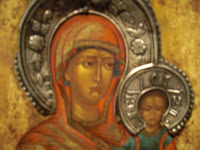
I don't normally equate where I live in central Florida -- orange groves, a world-famous mouse, grazing cattle, and the errant alligator or two -- with Old World culture or art. But in a wonderful slice of lagniappe*, a co-worker recently tipped me off to a temporary exhibit of Russian icons at nearby Florida Southern College. Entitled "Sacred Visions: Masterworks from the Museum of Russian Icons", the exhibit consists of 25 works from the private collection of Gordon Lankton, an entrepreneur whose business dealings took him to Russia and the discovery of religious icons surfacing again post-glastnost after decades of hiding from Bolshevics and Communists.

The icons on exhibit are as old as the 17th century and as recent as the early 21st century. Some of them feature favorite Russian saints (such as Paraskevi and Nicholas), others feature patriarchs from the Old Testament, one depicts a liturgical calendar, but most of them center around the Virgin Mary in the mode typical of Byzantine art -- stiff, one-dimensional frontal poses, solemn dark eyes, and holding the Child Jesus on a non-existent lap against a heavenly background. Like the Gothic art and architecture I've been studying, the symbolism and uniformity of subject matter of these pieces make it easy to understand icons as objects of instruction as well as veneration.

But beyond subject matter or motif, it's their sheer illumination that strikes you as enter the room (the afternoon I visited, I was the only one in the small gallery, and the icons stood in stark contrast to the bare white walls behind them). They seem to glow from within, and you can easily imagine how the family icon would become a captivating presence in a humble Russian home. The gallery provides the visitor with a magnifying glass, inviting you to get up close and examine the careful tempera brush strokes that bring this "gold" to life. So the obsession with light as representative of the heavenly realm continues long after the completion of the last Gothic cathedral!

Now back in the light after nearly a century of hiding in darkness, it's clear these treasures have not lost their shine nor their power!

(* lagniappe -- term originating in New Orleans referring to an unexpected blessing, something extra, a serendipitous gift such as the thirteenth beignet in a "baker's dozen")

Wednesday, December 30, 2009

Old friends and new discoveries

"The real voyage of discovery consists not in seeking new landscapes but in having new eyes." - Marcel Proust, French writer (1871-1922)

Home to southern Ohio for the holidays, and a chance to reconnect with family and old friends. Over lunch with my high school chum Vicki and her boyfriend Dave, we learn (or relearn?) that Dave's undergrad degree is in art, and he is a fellow "art nerd" with a few art history courses under his belt. This discovery leads to an afternoon excursion to downtown Middletown, Ohio to the Riordan Stained Glass Studio. The oldest such studio in the country, it's a veritable gem on a bleak, wintery day in a city that's been through hard times lately. Vicki lives in an historic, 19th century home and got to know the studio's owners and artists when she and her late husband commissioned a period reproduction stained glass panel for their stairway landing. She and Dave were eager to introduce us and let us have a peek at the jewels created within the walls of what I remember as the old Murphy's Five-and-Ten (way back in the '60s)!

As we enter Riordan's, I catch a glimpse of a group of priests in the back room (in their black cassocks and white collars), gathered around a work table and examining a sketch being explained by an artist. Turns out they're from a church in Kentucky that's expanding and installing new stained glass. For a brief second, I could envision a group of medieval clergy gathered around the glaziers' artist or the master mason of the cathedral project, giving their final approval to the guild's design or the architect's plan. Not a whole lot has changed over the last 800 years or so!

The studio creates anything from neo-Gothic designs to Tiffany-style lamps to contemporary secular work to finely detailed jewelry. Even on a gray December afternoon, the work samples lining the windows glow with their own fire. The owners invite Dave and me to rifle through their vast collection of art books, while Vicki and Cliff look on in bewildered amusement. I could have spent hours there and hope to make this a regular "pilgrimage" on trips home from now on. What fun!